What Is Message Architecture? A Complete Guide for B2B Companies
Most B2B companies don’t have a traffic problem. They have a clarity problem. Their messaging sounds familiar. It feels broad. It requires explanation.
And when buyers have to work to understand what you do, they hesitate. They compare. They delay decisions. They default to safer options. This is not just a copywriting issue. It’s a structural one. This is where message architecture comes in.

What Is Message Architecture?
The Definition
Message architecture is the structured framework that defines how a company communicates its value — including audience, problem, differentiation, proof, and decision path.
It is not just what you say. It’s how your message is organized, prioritized, and delivered so buyers can understand it quickly and act with confidence.
Message architecture sits beneath your website, your ads, your sales conversations, and your content. It is the system that holds your message together.
Think of it as a structural layer
Think of it less as a document and more as a structural layer.
Brand Strategy
Defines who you are.
Message Architecture
Governs the logic connecting the two — the sequencing, the hierarchy, the relationship between claims and evidence, and the path from problem recognition to purchase decision.
Copywriting
Expresses what you say.
Why Message Architecture Matters
When message architecture is weak, the business compensates. Buyers don’t understand quickly, don’t feel urgency, and don’t see clear differentiation. So they compare more, delay decisions, and push on price. Internally, sales teams explain too much, marketing produces more content to compensate, and new offers get added in an attempt to drive growth.
The Real Issue
But the issue isn’t effort. It’s structure.
The Mechanism
Clarity reduces decision friction. And decision friction is what slows revenue.
The Blind Spot
This is why most companies don’t realize they have a structural messaging problem until they look directly at it.
The Core Components of Message Architecture
A strong message architecture is built from a few key components. Each plays a specific role in helping the buyer move from interest to decision.
Audience Clarity
Who is this actually for? Not “companies of all sizes.” Not “anyone looking to grow.” A clear message reflects a specific buyer in a specific context. When audience clarity is strong, buyers recognize themselves immediately, relevance increases, and attention sharpens. When it’s weak, the message feels generic and the buyer has to decide whether it even applies to them. Audience specificity is not about limiting reach. It’s about increasing relevance. A message written for a defined buyer at a defined moment of decision will always outperform a message written to avoid excluding anyone.
Problem and Stakes
What problem exists — and why does it matter now? Many companies mention a problem. Fewer make it feel important. A strong message reflects a problem the buyer already feels, elevates the consequences, and introduces urgency. Without stakes, there is no reason to act. The stakes are what connect the problem to the buyer’s world — their risk, their timeline, their accountability. When stakes are absent, even a well-described problem reads as optional context rather than a reason to act.
Differentiating Mechanism
How does this work — and why is it different? This is where most messaging breaks down. Companies describe outcomes, benefits, and features — but not the system or mechanism behind them. The mechanism is what explains how results are achieved, makes the offer believable, and reduces the pressure to compare alternatives. Without a mechanism, every claim sounds interchangeable.
Weak: “We help companies automate payroll and reduce manual work.”
Strong: “We eliminate payroll errors for mid-market companies by replacing manual data entry with a rules engine that syncs directly with your HRIS — so your team stops auditing every run.”
One is an outcome. The other is a reason to believe it.
Proof and Credibility
Why should the buyer believe you? Claims create interest. Proof creates trust. Strong proof supports the type of claim being made, appears early enough to matter, and is specific rather than vague. Without proof, even a clear message carries perceived risk. Proof type must match claim type. A timeline claim requires process documentation. A results claim requires outcome data. A reliability claim requires track record evidence. Mismatched proof — deploying testimonials to support a methodology claim, for example — doesn’t just fail to convince. It can signal that stronger evidence doesn’t exist.
Consequences of Inaction
What happens if nothing changes? This component is often missing, and its absence is costly. Buyers don’t just evaluate upside. They evaluate risk, the cost of delay, and how they’ll justify a decision internally. A strong message makes it clear that doing nothing is not a neutral position — it has a cost, and that cost compounds. Consequences of inaction shift the frame from “should we buy this?” to “what is this delay actually costing us?” That is a fundamentally different decision environment.
Decision Path
What should the buyer do next? Clarity doesn’t end with understanding. It needs to extend into action. A strong decision path makes the next step obvious, matches the buyer’s level of readiness, and reduces perceived effort. When this is unclear, even interested buyers hesitate — not because they lack conviction, but because the path forward requires energy they weren’t prepared to spend.
Message Architecture vs. Positioning vs. Copywriting
These three are often confused, but they serve different roles.
Positioning
Defines where you sit in the market, what you own, and how you’re differentiated. Sets direction.
Message Architecture
Defines how that position is structured and communicated — how the pieces fit together. Carries it.
Copywriting
Expresses the words, tone, and delivery. Expresses it.
A company can occupy a genuinely differentiated position in the market and still lose deals because its message architecture doesn’t transmit that differentiation clearly enough to move a buyer from recognition to decision. This distinction matters because it determines where to intervene. When messaging isn’t working, the instinct is usually to fix the copy — tighten the language, rewrite the headlines, update the website. But if the problem is structural, rewriting the copy doesn’t solve it. It reschedules it.
Common Message Architecture Problems
Most companies don’t realize they have a message architecture issue until the symptoms become expensive. It shows up in patterns like:
Internal Signals
- “We have to explain this on every call.”
“People don’t quite get what we do at first.”
“We’re getting compared on price.”
These are not sales problems or product problems. They are message architecture problems.
The clearest diagnostic: the message makes sense after explanation — not on first read. If buyers only understand the value once a salesperson has walked them through it, the architecture is doing less than half its job.
How Weak Message Architecture Affects Revenue
This is where it becomes a business issue. When message architecture is unclear:
↑
Longer Sales Cycles
Sales teams spend more time clarifying, reframing, and justifying instead of closing.
↓
Close Rates Drop
The message is doing less work. So the business has to do more.
↑
Discounting Increases
Buyers push on price when differentiation isn’t clear.
↑
CAC Rises
Customer acquisition costs rise and marketing efficiency decreases.
How Message Architecture Affects an Entire Company
Executive Leadership
Executive leadership sets the source narrative — the clearest expression of why the company exists, where it is going, and what it believes
Communications & Brand
Communications & brand becomes the translation layer. It turns that strategic narrative into usable language, message pillars, tone, and talking points that other teams can work from.
Sales
Sales adapts that message to buyer context. Pitches, decks, and discovery calls should not invent a new story. They should apply the core story to customer pain, urgency, and fit.
Marketing
Marketing distributes the message across channels. Campaigns, ads, emails, and content should vary by audience and format, but still carry the same underlying architecture.
HR & People
HR & People bring the message inside the company. Values, onboarding, internal communications, and recruiting should reflect the same story the company is telling externally.
Product
Product turns the narrative into user experience. In-product copy, release notes, and feature communication should feel like they came from the same company as the CEO, the website, and the campaign.
Finance
Finance translates strategy into priorities, investment logic, and stakeholder communication. Budgets, forecasts, and board materials should reinforce the same direction, not compete with it.
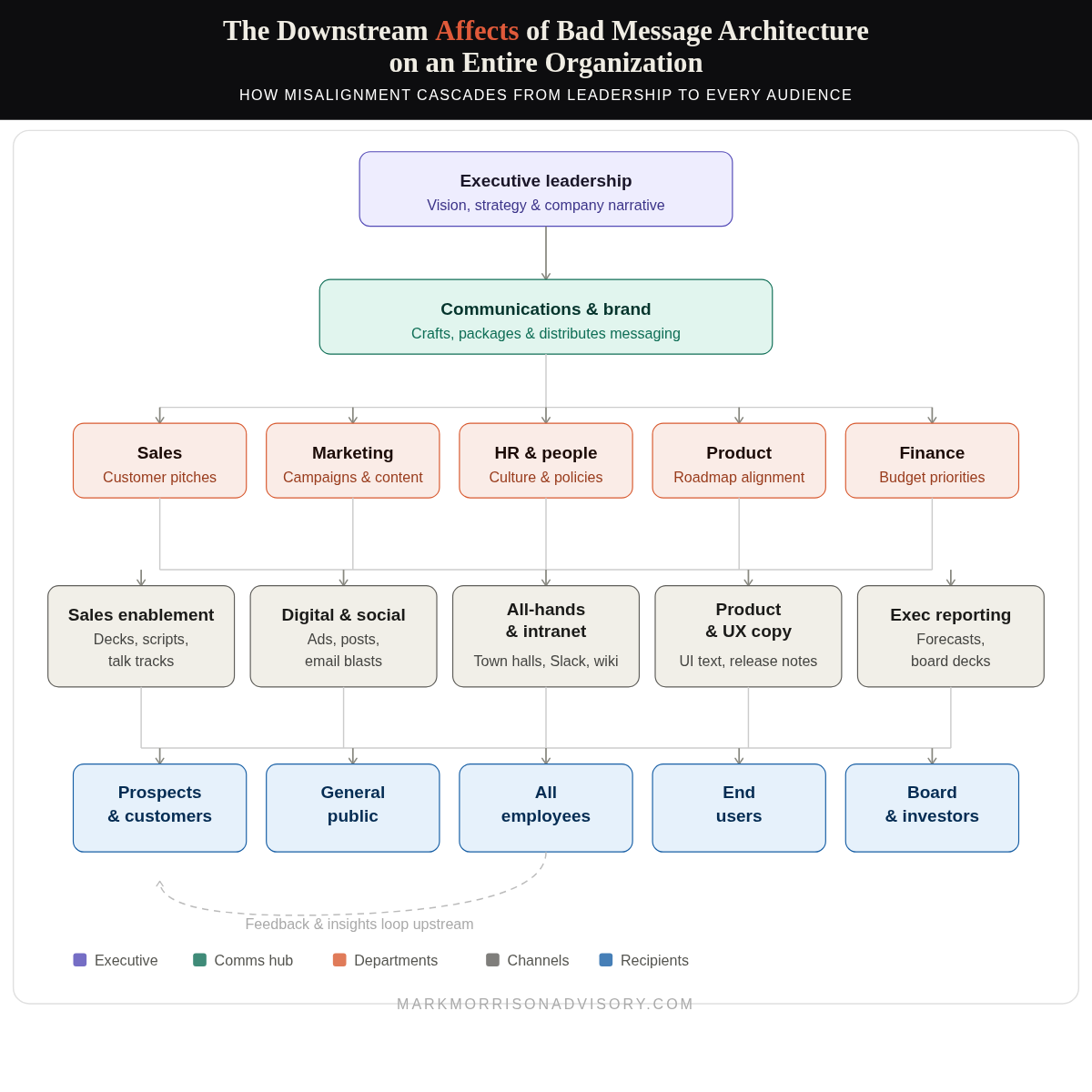
At every layer, the core idea should stay intact.
What changes is the audience, the format, and the depth.
The risk is drift.
The farther a message moves from the source, the easier it is for teams to reinterpret it, soften it, or replace it with their own version.
Strong message architecture prevents that.
It gives every team a shared foundation to translate from — not invent from.

How to Improve Your Message Architecture
Improving message architecture is not about rewriting everything at once. It’s about tightening the structure.
1. Narrow the Audience
Define who this is for, clearly and specifically.
2. Clarify the Problem
Make it concrete and consequential rather than implied.
3. Define the Mechanism
So buyers understand not just what you achieve but how you achieve it and why that process is different.
4. Align Proof with Claims
Ensuring the evidence type matches what’s being asserted.
5. Simplify the Hierarchy
So the core message carries the core job without requiring supporting context to make it legible.
These are not sequential steps that must be completed in order. They are structural elements that must be present and coherent together. Strengthening one without addressing the others rarely produces lasting improvement.
When to Fix Message Architecture
You don’t always need to rebuild your messaging. But there are clear signals when you should.
- Sales is working harder than it should.
- Messaging feels broad or interchangeable.
- Growth has plateaued.
- New offers are being added to compensate for conversion problems.
- Teams are not aligned on what the company does or how to describe it.
These are not always execution problems. Often, they are structural. And the distinction matters, because execution solutions — more content, more sales training, more campaigns — don’t resolve structural problems. They absorb the cost of them.
Message Architecture and Growth
The companies that win are not always the ones with the best product.
Often, they are the ones that are easiest to understand.
Clarity builds trust faster, reduces perceived risk, and accelerates decision-making. And over time, that compounds. A company with a clear message architecture creates a consistent buyer experience across every touchpoint — from the first impression on the website to the final conversation before a contract is signed. That consistency is itself a form of credibility.
When the structure is sound, the copy works harder. The sales conversation starts from a higher baseline. The buyer arrives already partially convinced. And the organization operates from a shared understanding of what it’s communicating and why.
That alignment has operational value. It reduces wasted motion, accelerates onboarding, and makes every new campaign easier to brief.
Message architecture is not a one-time fix. It’s a structural asset — one that appreciates when maintained and depreciates when neglected.
FAQ
What is message architecture in marketing?
Message architecture is the structured framework that defines how a company communicates its value, including audience, problem, differentiation, proof, and decision path.
.
How is message architecture different from positioning?
Positioning defines where you sit in the market. Message architecture defines how that position is structured and communicated across every buyer-facing touchpoint.
.
Why is message architecture important?
It reduces confusion, increases buyer understanding, and improves conversion by making decisions easier — while aligning internal teams around a consistent story.
.
What are the components of message architecture?
Audience clarity, problem and stakes, differentiating mechanism, proof and credibility, consequences of inaction, and decision path.
.
How do you improve message clarity?
By tightening the structure of your messaging — clarifying audience, problem, differentiation, and proof — and ensuring each component is coherent with the others.
.
What are the signs of a message architecture problem?
Deals that require extensive explanation to close, sales cycles longer than they should be, teams describing the company differently, pricing pressure without competitive justification, and marketing-generated leads that don’t convert at the rate they should.
.
Final Thought
Every click, scroll, and pause in a buying journey reflects the story your messaging is telling.
What story are you telling?
Messaging isn’t decoration. It’s infrastructure.
If your messaging is slowing decisions, creating unnecessary friction, or producing internal confusion about what the company stands for — it may not be an execution problem.
It may be structural.
