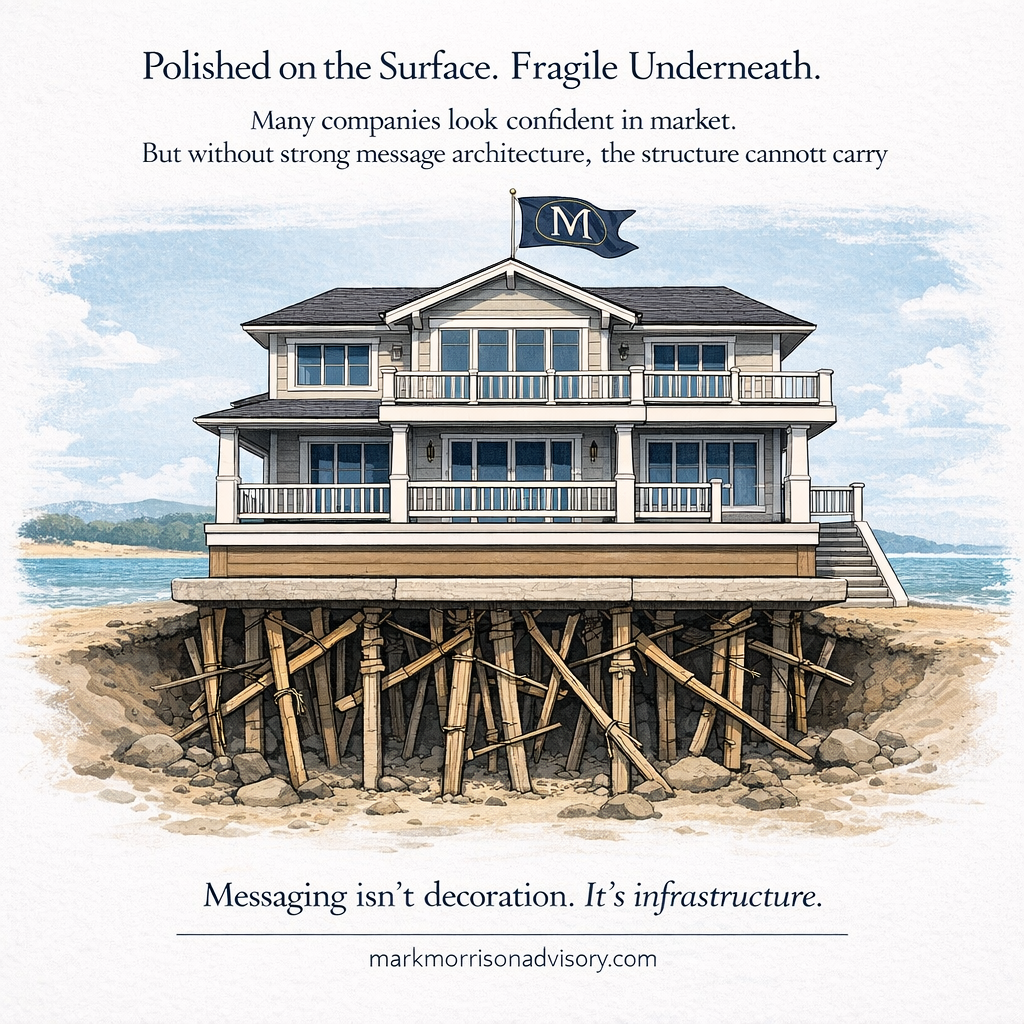

A strong position in the market means very little if the message underneath it collapses under scrutiny.
Positioning is not just where you sit in the market.
It’s how clearly a buyer can understand:
- what you are
- why it matters
- and why you’re different
That clarity doesn’t come from positioning alone.
It comes from the structure of the message underneath it.
Positioning sets the direction.
Message Architecture carries the weight.
If the structure is weak:
- the message feels broad
- the value feels interchangeable
- the buyer has to interpret
And when buyers have to interpret, they hesitate.
A strong position needs support.
At minimum, your message should clearly communicate:
- Who it’s for forces precision. If the message could apply to everyone, it lands with no one.
- What problem is at stake raises urgency. Not just the inconvenience, but the business cost of leaving it unresolved.
- How it’s solved differently creates separation. This is where positioning stops sounding interchangeable and starts becoming memorable.
- Why it should be trusted gives the claim weight. Proof, logic, credibility, and clarity all live here.
- What happens if nothing changes introduces consequence. Buyers do not move because something is interesting. They move because staying the same becomes too expensive.
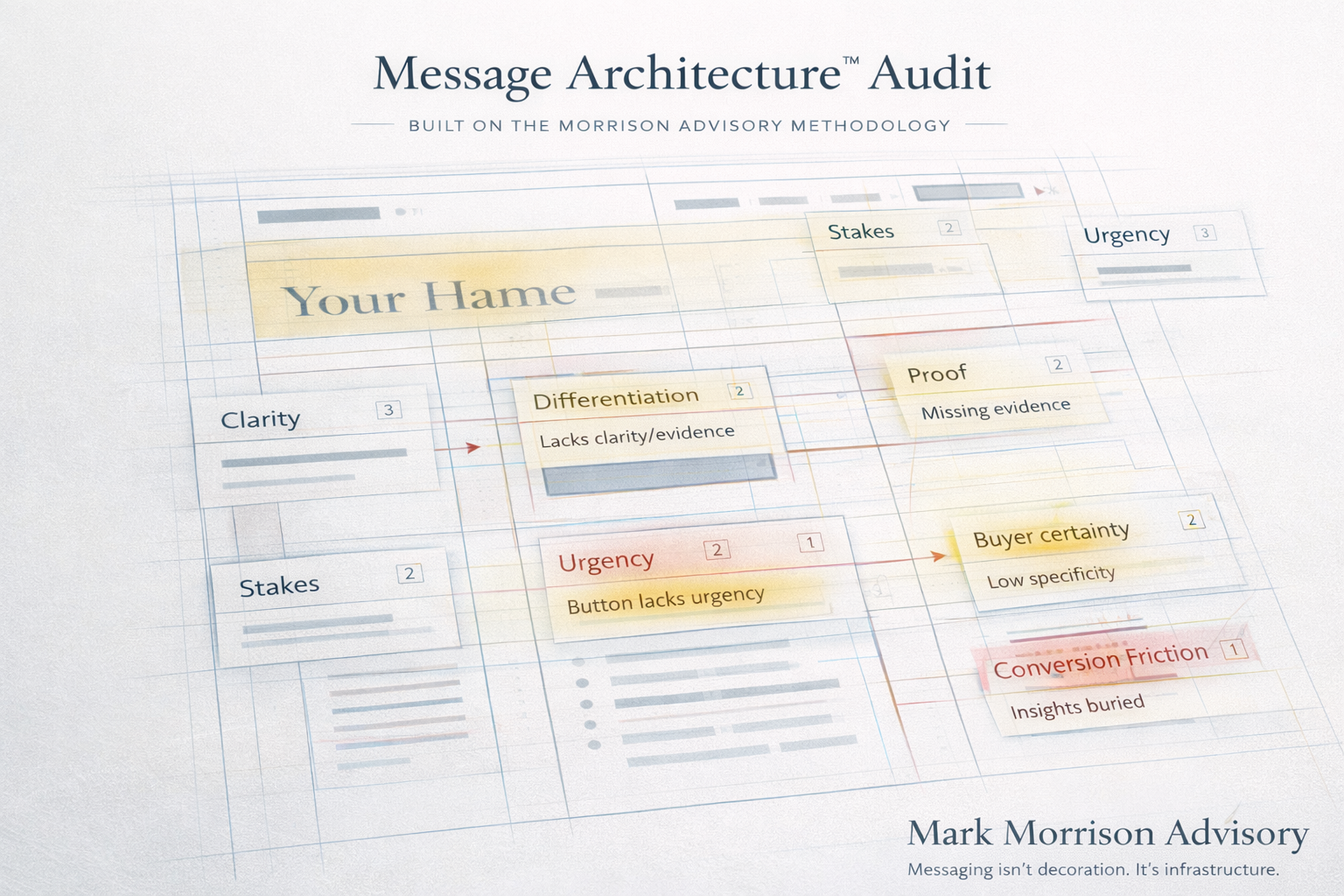
When these pillars are weak, the company may still look polished on the surface. But underneath, the structure cannot carry conviction, conversion, or pricing power.
That is the cost of shallow messaging.
It doesn’t always look broken.
It just quietly weakens the load-bearing parts of growth.
Most companies try to fix this by:
- rewriting headlines
- adjusting copy
- adding more content
But the issue isn’t surface-level.
It’s structural.
Message Architecture is the system that makes positioning real.
It connects your:
- audience
- problem
- mechanism
- proof
- and decision path
Into something a buyer can understand quickly and act on confidently.
Because in the end, positioning is not what you claim.
It’s what your messaging makes believable.
Every click, scroll, and pause in a buying journey reflects the story your messaging is telling.
What story are you telling?
Messaging isn’t decoration. It’s infrastructure.