
Most companies think their growth problems come from a lack of marketing activity.
More campaigns.
More content.
More optimization.
But often the problem sits somewhere deeper.
Shallow messaging.
Messaging that explains what a company does, but not why it matters or how it works differently.
At first glance, shallow messaging doesn’t look like a major problem.
The website reads fine.
The product seems capable.
Traffic is coming in.
But beneath the surface, shallow messaging creates three costly side effects.
1. More Objections
When messaging lacks depth, buyers are left to fill in the gaps.
What problem does this really solve?
How is this different from other options?
Why should we trust this approach?
Those questions don’t disappear.
They simply move into the sales conversation.
Sales teams spend more time explaining things the message should have already clarified.
2. Longer Sales Cycles
Serious buyers rarely make decisions quickly when clarity is missing.
Instead, they research.
They compare alternatives.
They ask additional questions.
They delay the decision until the picture feels clearer.
What looks like “normal buying behavior” is often uncertainty created by the message itself.
3. Pricing Pressure
When differentiation isn’t obvious, comparison becomes the buyer’s default strategy.
And comparison almost always introduces price.
Not because buyers only care about cost, but because the value difference hasn’t been clearly established.
Shallow messaging quietly pushes companies toward discounting.
Shallow messaging skims the surface. Strong messaging has depth, current, and pull.
Why This Happens
Many companies simplify their messaging to make it easier to read.
Shorter copy.
Fewer explanations.
Less detail.
But clarity doesn’t come from saying less.
Clarity comes from structural messaging.
Buyers need to understand:
- who the solution is for
- what problem is truly at stake
- how the solution works differently
- why the claims are credible
When these elements are missing, the message may feel simple—but it doesn’t create certainty.
And certainty is what moves decisions forward.
The Structural Reality
Strong messaging does more than attract attention.
It reduces friction.
It removes doubt.
It shortens decision paths.
It protects pricing power.
Because when the message carries weight, the buyer doesn’t need as much explanation.
The decision becomes easier.
Every click, scroll, and pause in a buying journey reflects the story your messaging is telling.
What story are you telling?
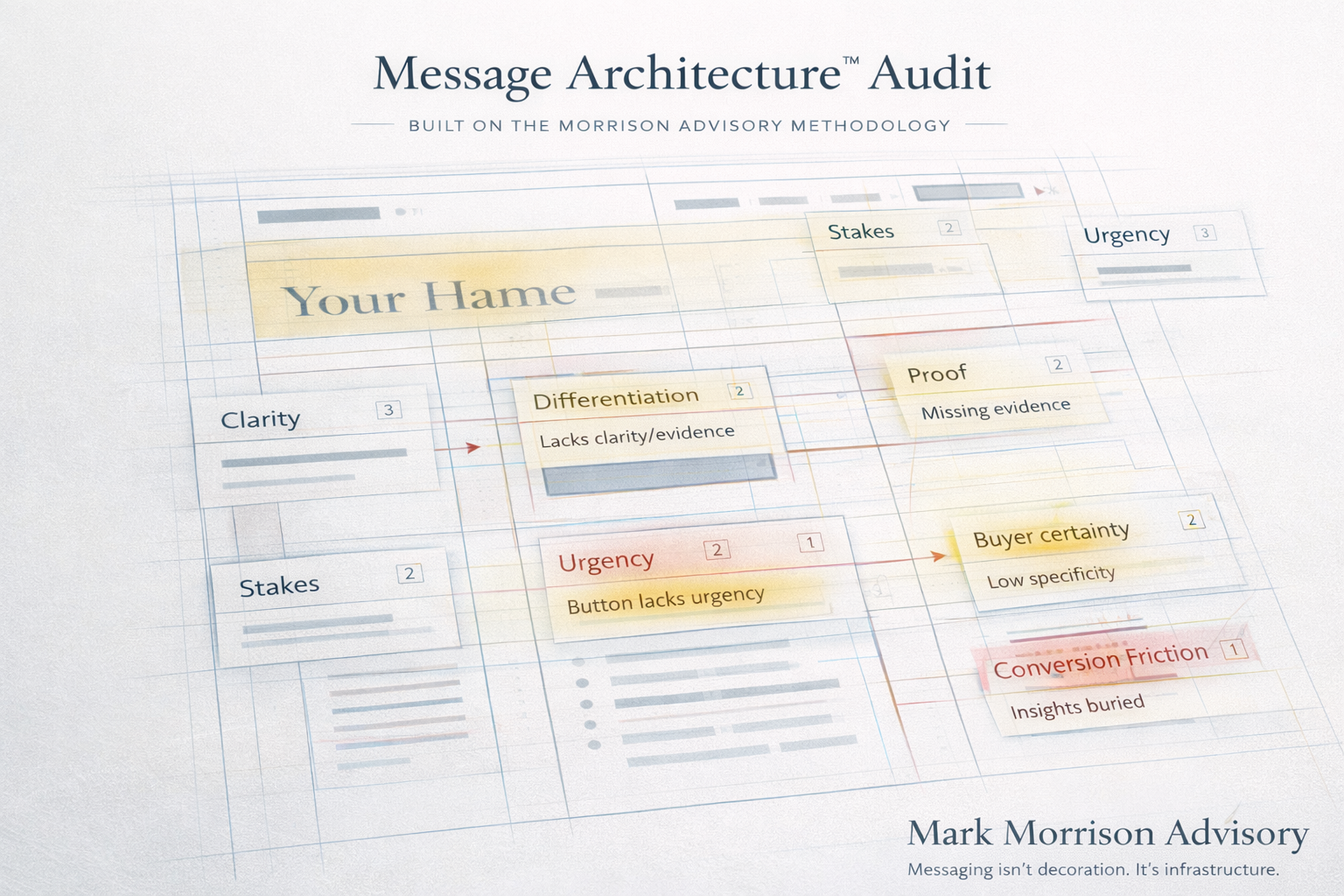
Messaging isn’t decoration.
It’s infrastructure.
If sales friction or unclear positioning is slowing growth, it may be worth a conversation.